


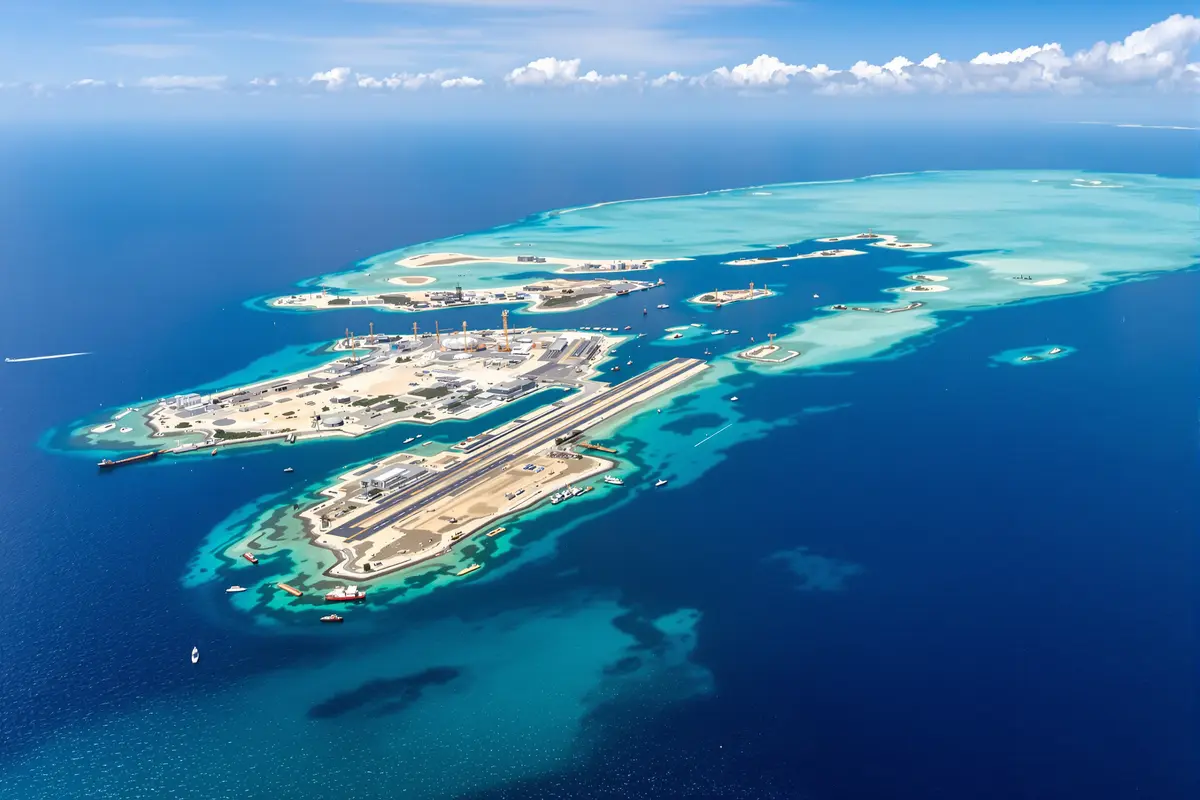
Imagine looking out at the open sea—and suddenly spotting a runway, radar dome, and military barracks where only waves used to be. Sounds like something from a movie, right? But this is real, and it’s happening in the South China Sea. Over the past 12 years, China has turned vast stretches of ocean into man-made islands. The transformations are bold, the strategy is sharp, and the consequences stretch far beyond the horizon.
How China turned reefs into real islands
For more than a decade, China has done something that once seemed impossible: it’s been building islands from scratch. The process looks futuristic, but it follows a clear formula.
- Specialized dredging ships suck sand and silt from the seabed.
- This material is pumped onto shallow reefs.
- Layer by layer, the sand builds up until it rises above the high tide line.
- Engineers stabilize the new land with concrete, steel, and rock.
- Then they construct infrastructure: airstrips, ports, radar systems, and housing.
One of the most dramatic examples is Fiery Cross Reef. Just a dot on old maps in 2012, it now holds a 3,000-meter runway and deepwater harbor. Similar scenes have played out on Subi Reef, Mischief Reef, and other sites across the Spratly Islands.
Beyond sand: the strategic goals behind the islands
So why go through all this effort? It’s not just about construction—it’s about control.
Under international law, “natural” islands can claim territorial waters and exclusive economic zones. That means whoever holds them could control the valuable fishing grounds, oil, gas, and trade routes nearby. But man-made structures? They don’t enjoy the same legal status.
Still, once an island is built and operational, it changes the facts on the water. Forget courtrooms—what matters now are the runways, radar stations, and military patrols that operate from these bases every day.
A key moment came in 2016, when an international tribunal ruled that Mischief Reef could not legally be turned into a full-fledged island. Yet the Chinese base there didn’t disappear. Instead, local fishermen now report being chased away, and surveillance equipment scans the seas daily.
The environmental cost under the waves
Building islands sounds impressive—but it comes at a serious environmental cost.
- Coral reefs are smothered under layers of sand and sediment.
- Marine life loses vital breeding and feeding grounds.
- Micro-ecosystems built over thousands of years are buried almost instantly.
Scientists warn that the South China Sea’s biodiversity is suffering. On top of warming waters and overfishing, this large-scale dredging is pushing the ecosystem to its breaking point.
Local communities feel the impact too. Coastal villages that depend on fishing are seeing their catches shrink. And it’s not just China—other nations may soon be tempted to copy these tactics in their own disputed waters.
The global consequences of artificial islands
These islands are changing more than just ocean views—they’re rewriting global norms. Here’s what’s at stake:
- Military tension: Every new airstrip raises the risk of close encounters between warships and fighter jets.
- Legal confusion: Man-made islands blur the lines of international maritime law.
- Environmental damage: Coral loss and seabed scars may last for generations.
- Economic ripple effects: Trade routes shift, affecting insurance, shipping, and fuel exploration.
- Global precedent: Other countries may see island-building as a new tool for claiming territory.
In short, the South China Sea may be the first stage of a much larger global trend where land is created—instead of protected—and power decides the rules.
What these islands reveal about our future
These new islands make us ask a deeper question: if we can build land where there was none, what else about the map can change?
As rising sea levels threaten coastlines, some countries are talking about floating cities, expanded ports, and more artificial platforms. The technology is here. But are the rules?
There’s a big risk: that the fastest builders will shape the ocean’s future, whether or not the world agrees. And once concrete is in place, it’s nearly impossible to roll it back.
Some see China’s actions as efficient and innovative. Others view them as dangerous and destabilizing. In between those views is a powerful truth: we’re changing the planet quickly—but learning slowly how to share it.








Leave a comment